
The U.S.–Iran standoff stayed volatile on Nov. 9: maritime attack claims and
missile reports rippled across the Gulf as Donald Trump said another U.S.
strike was not currently necessary. The posts offered no independent
confirmation of many battlefield claims, and accounts of negotiations
remained contradictory.
After meeting Qatar’s prime minister in Washington, Trump said Gulf states preferred the
status quo—a naval blockade and a land-and-sea operation he called “Iron Gate”—and that
Iran must not obtain nuclear weapons. He said renewed military action seemed unlikely for
now, though U.S. forces were ready if circumstances changed. A separate report said Saudi
Arabia, the United Arab Emirates, Qatar and Turkey were pressing him not to resume attacks;
the governments named did not confirm that view in the available posts. Iranian officials
rejected reports of a deal: one senior official denied that Mohsen Rezaei had met Vice
President JD Vance, while Tehran’s foreign ministry said removing enriched material was not
under consideration. Reports that Washington had accepted enrichment to 3.67% were
contradicted by a diplomatic denial. No agreement was established.
Around the Strait of Hormuz, posts described vessel fires, alleged missile or drone strikes,
explosions and attacks on shipping, often without vessel names, verified damage or consistent
attribution. Some said Iranian forces had targeted vessels deemed non-compliant; others
reported an oil tanker disabled after striking a mine. An Iranian account alleged that radar and
communications equipment on Oman’s Didamar Island had been struck, but the cause was not
established. Reports of Saudi Arabia’s East–West pipeline also diverged: a Saudi energy
ministry notice, as relayed in several posts, said the pipeline in Medina region was targeted
and a limited fire extinguished without injuries or operational impact. The notice did not
identify an attacker; a separate account blamed Ansar Allah, an attribution the posts did not
establish.
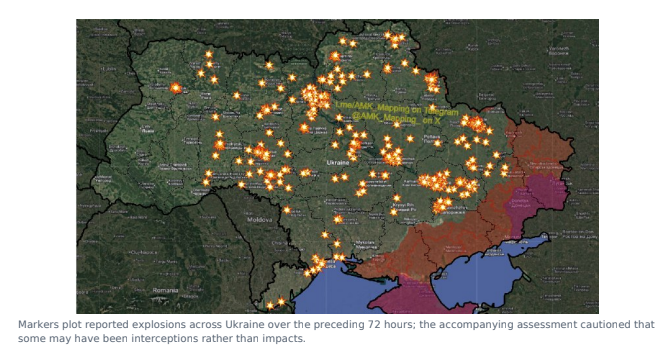
The conflict’s wider military picture remained uncertain. A forwarded assessment estimated
that Russia had used more than 1,000 drones and cruise missiles against Ukraine in 72 hours,
listing energy, rail, port and other infrastructure among possible targets. It mapped explosions
across hundreds of locations but cautioned that some may have been interceptions rather than
impacts.
In Yemen, posts reported missile launches toward Saudi targets including Riyadh, Khamis
Mushait and Abha. A Yemeni military spokesman claimed forces shot down a Saudi CH-4
drone over al-Jawf; no independent confirmation or damage assessment accompanied the
claim. A separate report of a suspected mistaken Saudi strike on allied Rapid Support forces
near al-Jawf was not corroborated.
Economic signals reflected hopes of de-escalation: one report put Brent below $100 a barrel,
while another reported a near-7% drop amid optimism over talks. A maritime assessment said
shipping through Hormuz was far below its 2025 average and reported 162 vessels waiting or
anchored around Fujairah and Khor Fakkan and 144 between Dubai/Jebel Ali and Ras Al
Khaimah; these were estimates, not a reconciled count. By evening, leaders had voiced
interest in restraint, but unresolved attacks, economic pressure and conflicting accounts of
negotiations left the next step unclear.
