
November 5, 2026
Reports of possible renewed U.S. strikes on Iran dominated Thursday, as military contingency planning and threats unfolded alongside diplomacy aimed at averting escalation. But no report described an order already issued, leaving the region confronting heightened risk without a confirmed next step. Early accounts said U.S. forces had carried out limited strikes on Iranian missile launchers and other equipment in recent weeks, reportedly without casualties. Later accounts described U.S.-Israeli plans for a short, intense operation that could target Iranian energy and nuclear infrastructure, missiles and drones. Political disagreement in Washington over whether to continue the war was also reported. These descriptions concerned past actions or contingencies, not a confirmed new order. Diplomacy moved in parallel. The Kremlin said Vladimir Putin met Iranian official Mohsen Rezaei; Rezaei’s reported account said he delivered a message from Iran’s leader and discussed regional security. Accounts differed over whether Tehran had sent a nuclear proposal through Qatar or was still weighing proposals, and said Iran had set seven conditions without listing them. No agreement was reported. Separately, a report said Saudi Arabia had sought Houthi ceasefire terms; the Houthis were said to demand $51 billion and recognition as Yemen’s rulers, a secondhand account that did not establish a formal offer or deal. At sea, Iranian military accounts described fires east of Hormuz but did not establish whether they involved one event or several: the Navy said two tankers it called violators struck mines, while other accounts described a tanker hit by a missile and a large tanker and tug catching fire. Vessel identities and damage remained unknown. A separate maritime warning described a tanker hit by two unidentified projectiles north of Qatar on Nov. 4. One report put Hormuz oil flows at about 7.8 million barrels a day—roughly 45% of prewar levels—and Gulf-to-Asia shipping costs near $37 a barrel in mid-October, without detail on the underlying measurements.
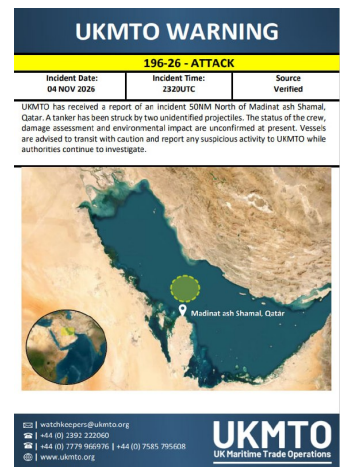
Claims of attacks and protective measures spread across the region. Ansar Allah said it struck Saudi-aligned forces in Yemen’s al-Jawf and claimed a drone attack disrupted Dammam airport; the reports gave no independently confirmed damage or duration. Another report
said Saudi aircraft struck Saada, leaving 13 civilians killed or wounded, including paramedics, but supplied no breakdown or corroboration. Iran’s Revolutionary Guard said electronic-warfare systems had disabled or downed additional U.S. reconnaissance drones over Qeshm; the number and outcome remained unconfirmed. Iraq was reported to have restricted its airspace Nov. 7–11, citing military activity, though the scope and reason were not detailed. Economic exposure appeared in airlines and energy facilities. Emirates’ first-half profit was reported to have fallen 66% year over year, with the Iran war cited as a cause; a fire at an Aramco facility was also reported, without details or confirmation. In Israel, shifting coalition endorsements were said to put Gadi Eisenkot in contention to form a government, though no appointment or new government was confirmed. The day’s reporting left shipping, energy infrastructure and diplomacy under strain, with threats and contingency plans moving ahead of any confirmed settlement.
