
Democrats were reported to have captured both chambers of Congress as President Donald Trump
acknowledged that the Iran war and higher gasoline costs may have contributed to Republican losses. Yet
the day’s accounts offered no settled picture of Washington’s next move: Iranian military claims multiplied,
Yemen’s forces announced attacks on Saudi-linked targets, and reports of possible renewed U.S. strikes
competed with mediation efforts.
The election picture remained fluid. Interim Senate projections ranged from 54 to 56 Democratic seats, while Mississippi’s
race was still close: Scott Colom led by 28 votes in one update and 43 in another. Maine and Michigan Senate races were
reported as Democratic pickups, but final vote totals were not supplied. Trump said voters might support his Iran policy but
had not accepted the short-term cost of higher gasoline prices. He defended his decision and said he would repeat it. Vice
President JD Vance blamed the war and the administration’s weak focus on the economy. Iranian Parliament Speaker
Mohammad-Baqer Qalibaf framed the results as a public rejection of war. These were competing political interpretations,
not proof of voters’ motives.
Iran’s Revolutionary Guard claimed it had shot down a U.S. MQ-9 over the Strait of Hormuz, calling it the 56th, and
intercepted an MQ-1 near Qeshm Island, its 15th. The claims circulated repeatedly, but neither aircraft loss nor cumulative
count was independently confirmed in the day’s reporting. Supreme Leader Mojtaba Khamenei warned that renewed U.S.
aggression would bring a broader response. Later reports described U.S. officials split between urging new strikes and
reducing operations. Qatari mediators were said to be seeking a draft to prevent renewed hostilities and possibly revive
direct talks. No attack order or agreement was confirmed.
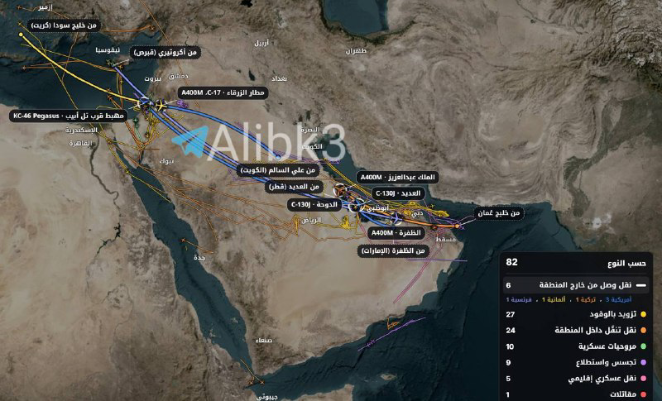
A same-day Arabic-language tally reported 82 military aircraft observed across the region over the preceding 24 hours,
including transport, refueling, reconnaissance and helicopter flights. Its graphic plotted routes over the Gulf and Arabian
Peninsula, but supplied no methodology; the count and tracks remain unverified.
In Yemen, military statements claimed a missile strike on a training camp in al-Dhale. Casualty estimates conflicted: one
said seven killed and more than 53 wounded; another, more than 10 dead and 40 wounded; a third described about 60
casualties. Yemeni forces separately claimed three or four operations against Saudi-linked sites in Jizan, Najran and
Riyadh. The reports did not establish impacts, damage or casualty totals.
Near day’s end, reports described a fire off Oman’s coast and speculated that a vessel might have been hit. They named no
ship or cause, leaving the incident unresolved. One economic report put Brent crude at $94 a barrel, down 9%, without a
pricing time; the single figure was not corroborated. Separately, the UAE’s ADNOC was reported to be weighing a third
crude-export pipeline from the western coast to Fujairah to reduce reliance on Hormuz. No approval or schedule was
reported.
In Israel, accounts said election authorities had found no evidence of irregularities while Benjamin Netanyahu raised
foreign-interference concerns. Coalition recommendations were reported at 56 for Gadi Eisenkot and 46 for Netanyahu,
but no government had formed
